How to contribute
We would love to accept your patches and contributions to this project. This document includes:
- Before you begin: Essential steps to take before becoming a Gemini CLI contributor.
- Code contribution process: How to contribute code to Gemini CLI.
- Development setup and workflow: How to set up your development environment and workflow.
- Documentation contribution process: How to contribute documentation to Gemini CLI.
We're looking forward to seeing your contributions!
Before you begin
Sign our Contributor License Agreement
Contributions to this project must be accompanied by a Contributor License Agreement (CLA). You (or your employer) retain the copyright to your contribution; this simply gives us permission to use and redistribute your contributions as part of the project.
If you or your current employer have already signed the Google CLA (even if it was for a different project), you probably don't need to do it again.
Visit https://cla.developers.google.com/ to see your current agreements or to sign a new one.
Review our Community Guidelines
This project follows Google's Open Source Community Guidelines.
Code contribution process
Get started
The process for contributing code is as follows:
- Find an issue that you want to work on. If an issue is tagged as
🔒Maintainers only, this means it is reserved for project maintainers. We will not accept pull requests related to these issues. In the near future, we will explicitly mark issues looking for contributions using thehelp-wantedlabel. If you believe an issue is a good candidate for community contribution, please leave a comment on the issue. A maintainer will review it and apply thehelp-wantedlabel if appropriate. Only maintainers should attempt to add thehelp-wantedlabel to an issue. - Fork the repository and create a new branch.
- Make your changes in the
packages/directory. - Ensure all checks pass by running
npm run preflight. - Open a pull request with your changes.
Code reviews
All submissions, including submissions by project members, require review. We use GitHub pull requests for this purpose.
To assist with the review process, we provide an automated review tool that helps detect common anti-patterns, testing issues, and other best practices that are easy to miss.
Using the automated review tool
You can run the review tool in two ways:
-
Using the helper script (Recommended): We provide a script that automatically handles checking out the PR into a separate worktree, installing dependencies, building the project, and launching the review tool.
./scripts/review.sh <PR_NUMBER> [model]Warning: If you run
scripts/review.sh, you must have first verified that the code for the PR being reviewed is safe to run and does not contain data exfiltration attacks.Authors are strongly encouraged to run this script on their own PRs immediately after creation. This allows you to catch and fix simple issues locally before a maintainer performs a full review.
Note on Models: By default, the script uses the latest Pro model (
gemini-3.1-pro-preview). If you do not have enough Pro quota, you can run it with the latest Flash model instead:./scripts/review.sh <PR_NUMBER> gemini-3-flash-preview. -
Manually from within Gemini CLI: If you already have the PR checked out and built, you can run the tool directly from the CLI prompt:
/review-frontend <PR_NUMBER>
Replace <PR_NUMBER> with your pull request number. Reviewers should use this
tool to augment, not replace, their manual review process.
Self-assigning and unassigning issues
To assign an issue to yourself, simply add a comment with the text /assign. To
unassign yourself from an issue, add a comment with the text /unassign.
The comment must contain only that text and nothing else. These commands will assign or unassign the issue as requested, provided the conditions are met (e.g., an issue must be unassigned to be assigned).
Please note that you can have a maximum of 3 issues assigned to you at any given time.
Pull request guidelines
To help us review and merge your PRs quickly, please follow these guidelines. PRs that do not meet these standards may be closed.
1. Link to an existing issue
All PRs should be linked to an existing issue in our tracker. This ensures that every change has been discussed and is aligned with the project's goals before any code is written.
- For bug fixes: The PR should be linked to the bug report issue.
- For features: The PR should be linked to the feature request or proposal issue that has been approved by a maintainer.
If an issue for your change doesn't exist, we will automatically close your PR along with a comment reminding you to associate the PR with an issue. The ideal workflow starts with an issue that has been reviewed and approved by a maintainer. Please open the issue first and wait for feedback before you start coding.
2. Keep it small and focused
We favor small, atomic PRs that address a single issue or add a single, self-contained feature.
- Do: Create a PR that fixes one specific bug or adds one specific feature.
- Don't: Bundle multiple unrelated changes (e.g., a bug fix, a new feature, and a refactor) into a single PR.
Large changes should be broken down into a series of smaller, logical PRs that can be reviewed and merged independently.
3. Use draft PRs for work in progress
If you'd like to get early feedback on your work, please use GitHub's Draft Pull Request feature. This signals to the maintainers that the PR is not yet ready for a formal review but is open for discussion and initial feedback.
4. Ensure all checks pass
Before submitting your PR, ensure that all automated checks are passing by
running npm run preflight. This command runs all tests, linting, and other
style checks.
5. Update documentation
If your PR introduces a user-facing change (e.g., a new command, a modified
flag, or a change in behavior), you must also update the relevant documentation
in the /docs directory.
See more about writing documentation: Documentation contribution process.
6. Write clear commit messages and a good PR description
Your PR should have a clear, descriptive title and a detailed description of the changes. Follow the Conventional Commits standard for your commit messages.
- Good PR title:
feat(cli): Add --json flag to 'config get' command - Bad PR title:
Made some changes
In the PR description, explain the "why" behind your changes and link to the
relevant issue (e.g., Fixes #123).
Forking
If you are forking the repository you will be able to run the Build, Test and
Integration test workflows. However in order to make the integration tests run
you'll need to add a
GitHub Repository Secret
with a value of GEMINI_API_KEY and set that to a valid API key that you have
available. Your key and secret are private to your repo; no one without access
can see your key and you cannot see any secrets related to this repo.
Additionally you will need to click on the Actions tab and enable workflows
for your repository, you'll find it's the large blue button in the center of the
screen.
Development setup and workflow
This section guides contributors on how to build, modify, and understand the development setup of this project.
Setting up the development environment
Prerequisites:
- Node.js:
- Development: Please use Node.js
~20.19.0. This specific version is required due to an upstream development dependency issue. You can use a tool like nvm to manage Node.js versions. - Production: For running the CLI in a production environment, any
version of Node.js
>=20is acceptable.
- Development: Please use Node.js
- Git
Build process
To clone the repository:
git clone https://github.com/google-gemini/gemini-cli.git # Or your fork's URL
cd gemini-cli
To install dependencies defined in package.json as well as root dependencies:
npm install
To build the entire project (all packages):
npm run build
This command typically compiles TypeScript to JavaScript, bundles assets, and
prepares the packages for execution. Refer to scripts/build.js and
package.json scripts for more details on what happens during the build.
Enabling sandboxing
Sandboxing is highly recommended and requires, at a minimum,
setting GEMINI_SANDBOX=true in your ~/.env and ensuring a sandboxing
provider (e.g. macOS Seatbelt, docker, or podman) is available. See
Sandboxing for details.
To build both the gemini CLI utility and the sandbox container, run
build:all from the root directory:
npm run build:all
To skip building the sandbox container, you can use npm run build instead.
Running the CLI
To start the Gemini CLI from the source code (after building), run the following command from the root directory:
npm start
If you'd like to run the source build outside of the gemini-cli folder, you can
utilize npm link path/to/gemini-cli/packages/cli (see:
docs) or
alias gemini="node path/to/gemini-cli/packages/cli" to run with gemini
Running tests
This project contains two types of tests: unit tests and integration tests.
Unit tests
To execute the unit test suite for the project:
npm run test
This will run tests located in the packages/core and packages/cli
directories. Ensure tests pass before submitting any changes. For a more
comprehensive check, it is recommended to run npm run preflight.
Integration tests
The integration tests are designed to validate the end-to-end functionality of
the Gemini CLI. They are not run as part of the default npm run test command.
To run the integration tests, use the following command:
npm run test:e2e
For more detailed information on the integration testing framework, please see the Integration Tests documentation.
Linting and preflight checks
To ensure code quality and formatting consistency, run the preflight check:
npm run preflight
This command will run ESLint, Prettier, all tests, and other checks as defined
in the project's package.json.
ProTip
after cloning create a git precommit hook file to ensure your commits are always clean.
echo "
# Run npm build and check for errors
if ! npm run preflight; then
  echo "npm build failed. Commit aborted."
  exit 1
fi
" > .git/hooks/pre-commit && chmod +x .git/hooks/pre-commit
Formatting
To separately format the code in this project by running the following command from the root directory:
npm run format
This command uses Prettier to format the code according to the project's style guidelines.
Linting
To separately lint the code in this project, run the following command from the root directory:
npm run lint
Coding conventions
- Please adhere to the coding style, patterns, and conventions used throughout the existing codebase.
- Consult GEMINI.md (typically found in the project root) for specific instructions related to AI-assisted development, including conventions for React, comments, and Git usage.
- Imports: Pay special attention to import paths. The project uses ESLint to enforce restrictions on relative imports between packages.
Project structure
packages/: Contains the individual sub-packages of the project.a2a-server: A2A server implementation for the Gemini CLI. (Experimental)cli/: The command-line interface.core/: The core backend logic for the Gemini CLI.test-utilsUtilities for creating and cleaning temporary file systems for testing.vscode-ide-companion/: The Gemini CLI Companion extension pairs with Gemini CLI.
docs/: Contains all project documentation.scripts/: Utility scripts for building, testing, and development tasks.
For more detailed architecture, see docs/architecture.md.
Debugging
VS Code
- Run the CLI to interactively debug in VS Code with
F5 - Start the CLI in debug mode from the root directory:
This command runs
npm run debugnode --inspect-brk dist/gemini.jswithin thepackages/clidirectory, pausing execution until a debugger attaches. You can then openchrome://inspectin your Chrome browser to connect to the debugger. - In VS Code, use the "Attach" launch configuration (found in
.vscode/launch.json).
Alternatively, you can use the "Launch Program" configuration in VS Code if you prefer to launch the currently open file directly, but 'F5' is generally recommended.
To hit a breakpoint inside the sandbox container run:
DEBUG=1 gemini
Note: If you have DEBUG=true in a project's .env file, it won't affect
gemini-cli due to automatic exclusion. Use .gemini/.env files for gemini-cli
specific debug settings.
React DevTools
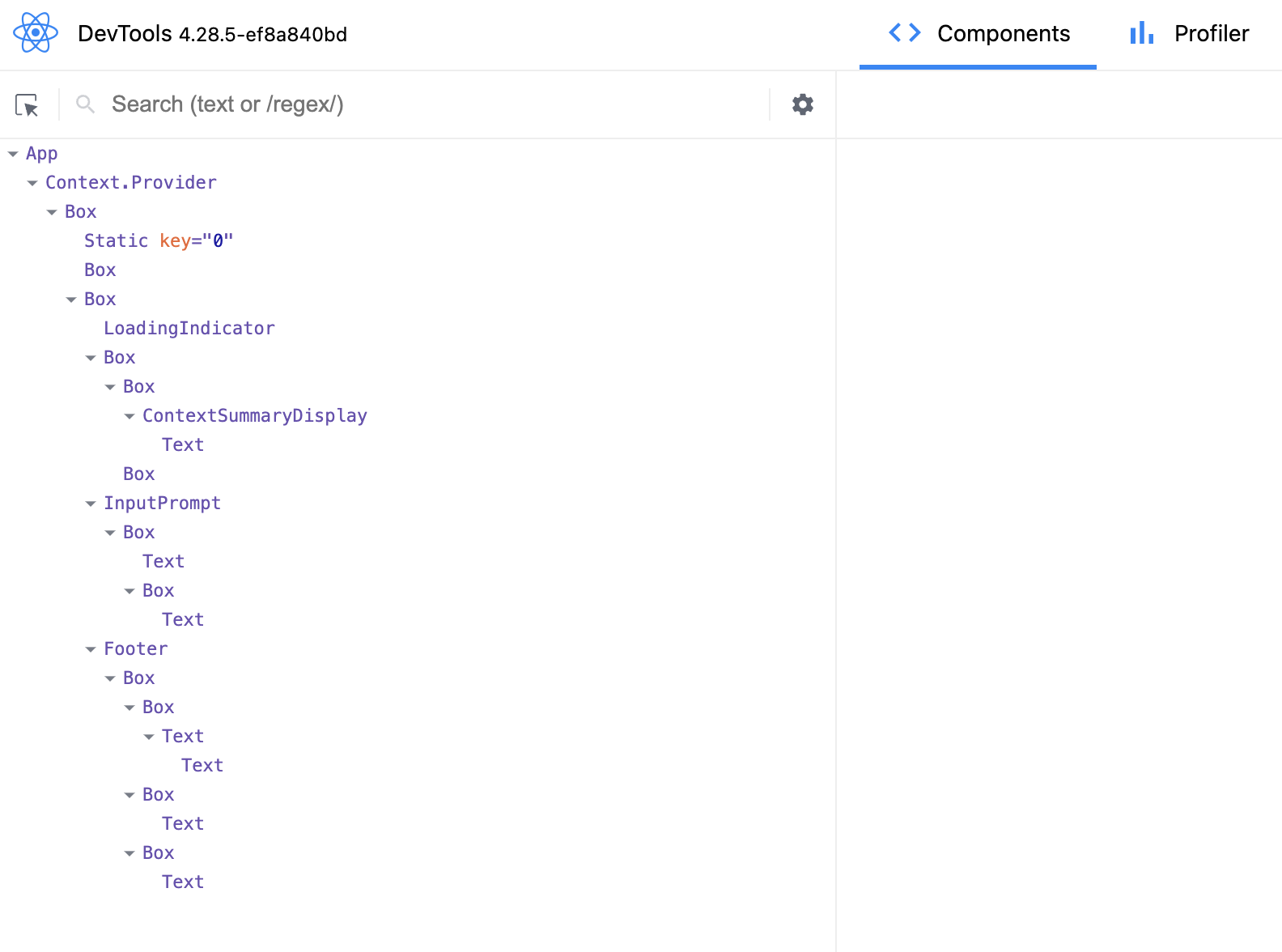
To debug the CLI's React-based UI, you can use React DevTools.
-
Start the Gemini CLI in development mode:
DEV=true npm start -
Install and run React DevTools version 6 (which matches the CLI's
react-devtools-core):You can either install it globally:
npm install -g react-devtools@6
react-devtools
Or run it directly using npx:
npx react-devtools@6Your running CLI application should then connect to React DevTools.
Sandboxing
macOS Seatbelt
On macOS, gemini uses Seatbelt (sandbox-exec) under a permissive-open
profile (see packages/cli/src/utils/sandbox-macos-permissive-open.sb) that
restricts writes to the project folder but otherwise allows all other operations
and outbound network traffic ("open") by default. You can switch to a
strict-open profile (see
packages/cli/src/utils/sandbox-macos-strict-open.sb) that restricts both reads
and writes to the working directory while allowing outbound network traffic by
setting SEATBELT_PROFILE=strict-open in your environment or .env file.
Available built-in profiles are permissive-{open,proxied},
restrictive-{open,proxied}, and strict-{open,proxied} (see below for proxied
networking). You can also switch to a custom profile
SEATBELT_PROFILE=<profile> if you also create a file
.gemini/sandbox-macos-<profile>.sb under your project settings directory
.gemini.
Container-based sandboxing (all platforms)
For stronger container-based sandboxing on macOS or other platforms, you can set
GEMINI_SANDBOX=true|docker|podman|<command> in your environment or .env
file. The specified command (or if true then either docker or podman) must
be installed on the host machine. Once enabled, npm run build:all will build a
minimal container ("sandbox") image and npm start will launch inside a fresh
instance of that container. The first build can take 20-30s (mostly due to
downloading of the base image) but after that both build and start overhead
should be minimal. Default builds (npm run build) will not rebuild the
sandbox.
Container-based sandboxing mounts the project directory (and system temp
directory) with read-write access and is started/stopped/removed automatically
as you start/stop Gemini CLI. Files created within the sandbox should be
automatically mapped to your user/group on host machine. You can easily specify
additional mounts, ports, or environment variables by setting
SANDBOX_{MOUNTS,PORTS,ENV} as needed. You can also fully customize the sandbox
for your projects by creating the files .gemini/sandbox.Dockerfile and/or
.gemini/sandbox.bashrc under your project settings directory (.gemini) and
running gemini with BUILD_SANDBOX=1 to trigger building of your custom
sandbox.
Proxied networking
All sandboxing methods, including macOS Seatbelt using *-proxied profiles,
support restricting outbound network traffic through a custom proxy server that
can be specified as GEMINI_SANDBOX_PROXY_COMMAND=<command>, where <command>
must start a proxy server that listens on :::8877 for relevant requests. See
docs/examples/proxy-script.md for a minimal proxy that only allows HTTPS
connections to example.com:443 (e.g. curl https://example.com) and declines
all other requests. The proxy is started and stopped automatically alongside the
sandbox.
Manual publish
We publish an artifact for each commit to our internal registry. But if you need to manually cut a local build, then run the following commands:
npm run clean
npm install
npm run auth
npm run prerelease:dev
npm publish --workspaces
Documentation contribution process
Our documentation must be kept up-to-date with our code contributions. We want our documentation to be clear, concise, and helpful to our users. We value:
- Clarity: Use simple and direct language. Avoid jargon where possible.
- Accuracy: Ensure all information is correct and up-to-date.
- Completeness: Cover all aspects of a feature or topic.
- Examples: Provide practical examples to help users understand how to use Gemini CLI.
Getting started
The process for contributing to the documentation is similar to contributing code.
- Fork the repository and create a new branch.
- Make your changes in the
/docsdirectory. - Preview your changes locally in Markdown rendering.
- Lint and format your changes. Our preflight check includes linting and
formatting for documentation files.
npm run preflight - Open a pull request with your changes.
Documentation structure
Our documentation is organized using sidebar.json as the table of contents. When adding new documentation:
- Create your markdown file in the appropriate directory under
/docs. - Add an entry to
sidebar.jsonin the relevant section. - Ensure all internal links use relative paths and point to existing files.
Style guide
We follow the Google Developer Documentation Style Guide. Please refer to it for guidance on writing style, tone, and formatting.
Key style points
- Use sentence case for headings.
- Write in second person ("you") when addressing the reader.
- Use present tense.
- Keep paragraphs short and focused.
- Use code blocks with appropriate language tags for syntax highlighting.
- Include practical examples whenever possible.
Linting and formatting
We use prettier to enforce a consistent style across our documentation. The
npm run preflight command will check for any linting issues.
You can also run the linter and formatter separately:
npm run lint- Check for linting issuesnpm run format- Auto-format markdown filesnpm run lint:fix- Auto-fix linting issues where possible
Please make sure your contributions are free of linting errors before submitting a pull request.
Before you submit
Before submitting your documentation pull request, please:
- Run
npm run preflightto ensure all checks pass. - Review your changes for clarity and accuracy.
- Check that all links work correctly.
- Ensure any code examples are tested and functional.
- Sign the Contributor License Agreement (CLA) if you haven't already.
Need help?
If you have questions about contributing documentation:
- Check our FAQ.
- Review existing documentation for examples.
- Open an issue to discuss your proposed changes.
- Reach out to the maintainers.
We appreciate your contributions to making Gemini CLI documentation better!