Observability with OpenTelemetry
Observability is the key to turning experimental AI into reliable software. Gemini CLI provides built-in support for OpenTelemetry, transforming every agent interaction into a rich stream of logs, metrics, and traces. This three-pillar approach gives you the high-fidelity visibility needed to understand agent behavior, optimize performance, and ensure reliability across your entire workflow.
Whether you are debugging a complex tool interaction locally or monitoring enterprise-wide usage in the cloud, Gemini CLI's observability system provides the actionable intelligence needed to move from "black box" AI to predictable, high-performance systems.
OpenTelemetry integration
Gemini CLI integrates with OpenTelemetry, a vendor-neutral, industry-standard observability framework.
The observability system provides:
- Universal compatibility: Export to any OpenTelemetry backend (Google Cloud, Jaeger, Prometheus, Datadog, etc.).
- Standardized data: Use consistent formats and collection methods across your toolchain.
- Future-proof integration: Connect with existing and future observability infrastructure.
- No vendor lock-in: Switch between backends without changing your instrumentation.
Configuration
You control telemetry behavior through the .gemini/settings.json file.
Environment variables can override these settings.
| Setting | Environment Variable | Description | Values | Default |
|---|---|---|---|---|
enabled | GEMINI_TELEMETRY_ENABLED | Enable or disable telemetry | true/false | false |
target | GEMINI_TELEMETRY_TARGET | Where to send telemetry data | "gcp"/"local" | "local" |
otlpEndpoint | GEMINI_TELEMETRY_OTLP_ENDPOINT | OTLP collector endpoint | URL string | http://localhost:4317 |
otlpProtocol | GEMINI_TELEMETRY_OTLP_PROTOCOL | OTLP transport protocol | "grpc"/"http" | "grpc" |
outfile | GEMINI_TELEMETRY_OUTFILE | Save telemetry to file (overrides otlpEndpoint) | file path | - |
logPrompts | GEMINI_TELEMETRY_LOG_PROMPTS | Include prompts in telemetry logs | true/false | true |
useCollector | GEMINI_TELEMETRY_USE_COLLECTOR | Use external OTLP collector (advanced) | true/false | false |
useCliAuth | GEMINI_TELEMETRY_USE_CLI_AUTH | Use CLI credentials for telemetry (GCP target only) | true/false | false |
| - | GEMINI_CLI_SURFACE | Optional custom label for traffic reporting | string | - |
Note on boolean environment variables: For boolean settings like enabled,
setting the environment variable to true or 1 enables the feature.
For detailed configuration information, see the Configuration guide.
Google Cloud telemetry
You can export telemetry data directly to Google Cloud Trace, Cloud Monitoring, and Cloud Logging.
Prerequisites
You must complete several setup steps before enabling Google Cloud telemetry.
-
Set your Google Cloud project ID:
-
To send telemetry to a separate project:
macOS/Linux
export OTLP_GOOGLE_CLOUD_PROJECT="your-telemetry-project-id"Windows (PowerShell)
$env:OTLP_GOOGLE_CLOUD_PROJECT="your-telemetry-project-id" -
To send telemetry to the same project as inference:
macOS/Linux
export GOOGLE_CLOUD_PROJECT="your-project-id"Windows (PowerShell)
$env:GOOGLE_CLOUD_PROJECT="your-project-id"
-
-
Authenticate with Google Cloud using one of these methods:
- Method A: Application Default Credentials (ADC): Use this method for
service accounts or standard
gcloudauthentication.-
For user accounts:
gcloud auth application-default login -
For service accounts:
macOS/Linux
export GOOGLE_APPLICATION_CREDENTIALS="/path/to/your/service-account.json"Windows (PowerShell)
$env:GOOGLE_APPLICATION_CREDENTIALS="C:\path\to\your\service-account.json"
-
-
Method B: CLI Auth (Direct export only): Simplest method for local users. Gemini CLI uses the same OAuth credentials you used for login. To enable this, set
useCliAuth: truein your.gemini/settings.json:{
"telemetry": {
"enabled": true,
"target": "gcp",
"useCliAuth": true
}
}Note: This setting requires Direct export (in-process exporters) and cannot be used when
useCollectoristrue. If both are enabled, telemetry will be disabled.
- Method A: Application Default Credentials (ADC): Use this method for
service accounts or standard
-
Ensure your account or service account has these IAM roles:
- Cloud Trace Agent
- Monitoring Metric Writer
- Logs Writer
-
Enable the required Google Cloud APIs:
gcloud services enable \
  cloudtrace.googleapis.com \
  monitoring.googleapis.com \
  logging.googleapis.com \
  --project="$OTLP_GOOGLE_CLOUD_PROJECT"
Direct export
We recommend using direct export to send telemetry directly to Google Cloud services.
- Enable telemetry in
.gemini/settings.json:{
"telemetry": {
"enabled": true,
"target": "gcp"
}
} - Run Gemini CLI and send prompts.
- View logs, metrics, and traces in the Google Cloud Console. See View Google Cloud telemetry for details.
View Google Cloud telemetry
After you enable telemetry and run Gemini CLI, you can view your data in the Google Cloud Console.
- Logs: Logs Explorer
- Metrics: Metrics Explorer
- Traces: Trace Explorer
For detailed information on how to use these tools, see the following official Google Cloud documentation:
- View and analyze logs with Logs Explorer
- Create charts with Metrics Explorer
- Find and explore traces
Monitoring dashboards
Gemini CLI provides a pre-configured Google Cloud Monitoring dashboard to visualize your telemetry.
Find this dashboard under Google Cloud Monitoring Dashboard Templates as "Gemini CLI Monitoring".
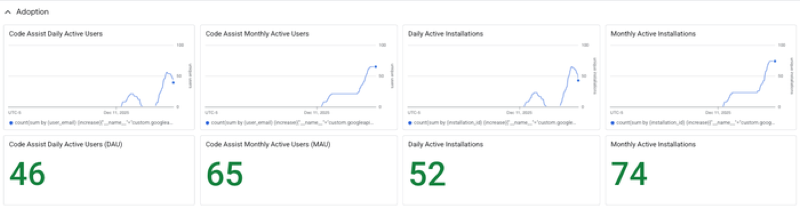
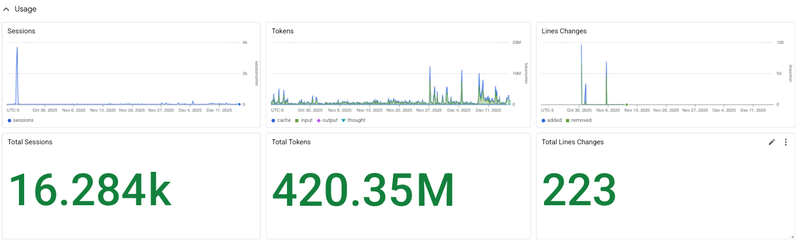
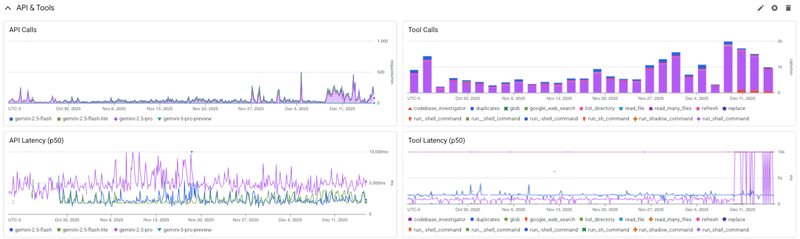
To learn more, see Instant insights: Gemini CLI’s pre-configured monitoring dashboards.
Local telemetry
You can capture telemetry data locally for development and debugging. We recommend using file-based output for local development.
- Enable telemetry in
.gemini/settings.json:{
"telemetry": {
"enabled": true,
"target": "local",
"outfile": ".gemini/telemetry.log"
}
} - Run Gemini CLI and send prompts.
- View logs and metrics in
.gemini/telemetry.log.
For advanced local telemetry setups (such as Jaeger or Genkit), see the Local development guide.
Client identification
Gemini CLI includes identifiers in its User-Agent header to help you
differentiate and report on API traffic from different environments (for
example, identifying calls from Gemini Code Assist versus a standard terminal).
Automatic identification
Most integrated environments are identified automatically without additional
configuration. The identifier is included as a prefix to the User-Agent and as
a "surface" tag in the parenthetical metadata.
| Environment | User-Agent Prefix | Surface Tag |
|---|---|---|
| Gemini Code Assist (Agent Mode) | GeminiCLI-a2a-server | vscode |
| Zed (via ACP) | GeminiCLI-acp-zed | zed |
| XCode (via ACP) | GeminiCLI-acp-xcode | xcode |
| IntelliJ IDEA (via ACP) | GeminiCLI-acp-intellijidea | jetbrains |
| Standard Terminal | GeminiCLI | terminal |
Example User-Agent:
GeminiCLI-a2a-server/0.34.0/gemini-pro (linux; x64; vscode)
Custom identification
You can provide a custom identifier for your own scripts or automation by
setting the GEMINI_CLI_SURFACE environment variable. This is useful for
tracking specific internal tools or distribution channels in your GCP logs.
macOS/Linux
export GEMINI_CLI_SURFACE="my-custom-tool"
Windows (PowerShell)
$env:GEMINI_CLI_SURFACE="my-custom-tool"
When set, the value appears at the end of the User-Agent parenthetical:
GeminiCLI/0.34.0/gemini-pro (linux; x64; my-custom-tool)
Logs, metrics, and traces
This section describes the structure of logs, metrics, and traces generated by Gemini CLI.
Gemini CLI includes session.id, installation.id, active_approval_mode, and
user.email (when authenticated) as common attributes on all data.
Logs
Logs provide timestamped records of specific events. Gemini CLI logs events across several categories.
Sessions
Session logs capture startup configuration and prompt submissions.
gemini_cli.config
Emitted at startup with the CLI configuration.
Attributes
model(string)embedding_model(string)sandbox_enabled(boolean)core_tools_enabled(string)approval_mode(string)api_key_enabled(boolean)vertex_ai_enabled(boolean)log_user_prompts_enabled(boolean)file_filtering_respect_git_ignore(boolean)debug_mode(boolean)mcp_servers(string)mcp_servers_count(int)mcp_tools(string)mcp_tools_count(int)output_format(string)extensions(string)extension_ids(string)extensions_count(int)auth_type(string)github_workflow_name(string, optional)github_repository_hash(string, optional)github_event_name(string, optional)github_pr_number(string, optional)github_issue_number(string, optional)github_custom_tracking_id(string, optional)
gemini_cli.user_prompt
Emitted when you submit a prompt.
Attributes
prompt_length(int)prompt_id(string)prompt(string; excluded iftelemetry.logPromptsisfalse)auth_type(string)
Approval mode
These logs track changes to and usage of different approval modes.
Lifecycle
approval_mode_switch
Logs when you change the approval mode.
Attributes
from_mode(string)to_mode(string)
approval_mode_duration
Records time spent in an approval mode.
Attributes
mode(string)duration_ms(int)
Execution
plan_execution
Logs when you execute a plan and switch from plan mode to active execution.
Attributes
approval_mode(string)
Tools
Tool logs capture executions, truncation, and edit behavior.
gemini_cli.tool_call
Emitted for each tool (function) call.
Attributes
function_name(string)function_args(string)duration_ms(int)success(boolean)decision(string: "accept", "reject", "auto_accept", or "modify")error(string, optional)error_type(string, optional)prompt_id(string)tool_type(string: "native" or "mcp")mcp_server_name(string, optional)extension_name(string, optional)extension_id(string, optional)content_length(int, optional)start_time(number, optional)end_time(number, optional)metadata(object, optional), which may include:model_added_lines(number)model_removed_lines(number)user_added_lines(number)user_removed_lines(number)ask_user(object)
gemini_cli.tool_output_truncated
Logs when tool output is truncated.
Attributes
tool_name(string)original_content_length(int)truncated_content_length(int)threshold(int)lines(int)prompt_id(string)
gemini_cli.edit_strategy
Records the chosen edit strategy.
Attributes
strategy(string)
gemini_cli.edit_correction
Records the result of an edit correction.
Attributes
correction(string: "success" or "failure")
gen_ai.client.inference.operation.details
Provides detailed GenAI operation data aligned with OpenTelemetry conventions.
Attributes
gen_ai.request.model(string)gen_ai.provider.name(string)gen_ai.operation.name(string)gen_ai.input.messages(json string)gen_ai.output.messages(json string)gen_ai.response.finish_reasons(array of strings)gen_ai.usage.input_tokens(int)gen_ai.usage.output_tokens(int)gen_ai.request.temperature(float)gen_ai.request.top_p(float)gen_ai.request.top_k(int)gen_ai.request.max_tokens(int)gen_ai.system_instructions(json string)server.address(string)server.port(int)
Files
File logs track operations performed by tools.
gemini_cli.file_operation
Emitted for each file creation, read, or update.
Attributes
tool_name(string)operation(string: "create", "read", or "update")lines(int, optional)mimetype(string, optional)extension(string, optional)programming_language(string, optional)
API
API logs capture requests, responses, and errors from Gemini API.
gemini_cli.api_request
Request sent to Gemini API.
Attributes
model(string)prompt_id(string)role(string: "user", "model", or "system")request_text(string, optional)
gemini_cli.api_response
Response received from Gemini API.
Attributes
model(string)status_code(int or string)duration_ms(int)input_token_count(int)output_token_count(int)cached_content_token_count(int)thoughts_token_count(int)tool_token_count(int)total_token_count(int)prompt_id(string)auth_type(string)finish_reasons(array of strings)response_text(string, optional)
gemini_cli.api_error
Logs when an API request fails.
Attributes
error.message(string)model_name(string)duration(int)prompt_id(string)auth_type(string)error_type(string, optional)status_code(int or string, optional)role(string, optional)
gemini_cli.malformed_json_response
Logs when a JSON response cannot be parsed.
Attributes
model(string)
Model routing
These logs track how Gemini CLI selects and routes requests to models.
gemini_cli.slash_command
Logs slash command execution.
Attributes
command(string)subcommand(string, optional)status(string: "success" or "error")
gemini_cli.slash_command.model
Logs model selection via slash command.
Attributes
model_name(string)
gemini_cli.model_routing
Records model router decisions and reasoning.
Attributes
decision_model(string)decision_source(string)routing_latency_ms(int)reasoning(string, optional)failed(boolean)error_message(string, optional)approval_mode(string)
Chat and streaming
These logs track chat context compression and streaming chunk errors.
gemini_cli.chat_compression
Logs chat context compression events.
Attributes
tokens_before(int)tokens_after(int)
gemini_cli.chat.invalid_chunk
Logs invalid chunks received in a stream.
Attributes
error_message(string, optional)
gemini_cli.chat.content_retry
Logs retries due to content errors.
Attributes
attempt_number(int)error_type(string)retry_delay_ms(int)model(string)
gemini_cli.chat.content_retry_failure
Logs when all content retries fail.
Attributes
total_attempts(int)final_error_type(string)total_duration_ms(int, optional)model(string)
gemini_cli.conversation_finished
Logs when a conversation session ends.
Attributes
approvalMode(string)turnCount(int)
Resilience
Resilience logs record fallback mechanisms and recovery attempts.
gemini_cli.flash_fallback
Logs switch to a flash model fallback.
Attributes
auth_type(string)
gemini_cli.ripgrep_fallback
Logs fallback to standard grep.
Attributes
error(string, optional)
gemini_cli.web_fetch_fallback_attempt
Logs web-fetch fallback attempts.
Attributes
reason(string: "private_ip" or "primary_failed")
gemini_cli.agent.recovery_attempt
Logs attempts to recover from agent errors.
Attributes
agent_name(string)attempt_number(int)success(boolean)error_type(string, optional)
Extensions
Extension logs track lifecycle events and settings changes.
gemini_cli.extension_install
Logs when you install an extension.
Attributes
extension_name(string)extension_version(string)extension_source(string)status(string)
gemini_cli.extension_uninstall
Logs when you uninstall an extension.
Attributes
extension_name(string)status(string)
gemini_cli.extension_enable
Logs when you enable an extension.
Attributes
extension_name(string)setting_scope(string)
gemini_cli.extension_disable
Logs when you disable an extension.
Attributes
extension_name(string)setting_scope(string)
Agent runs
Agent logs track the lifecycle of agent executions.
gemini_cli.agent.start
Logs when an agent run begins.
Attributes
agent_id(string)agent_name(string)
gemini_cli.agent.finish
Logs when an agent run completes.
Attributes
agent_id(string)agent_name(string)duration_ms(int)turn_count(int)terminate_reason(string)
IDE
IDE logs capture connectivity events for the IDE companion.
gemini_cli.ide_connection
Logs IDE companion connections.
Attributes
connection_type(string)
UI
UI logs track terminal rendering issues.
kitty_sequence_overflow
Logs terminal control sequence overflows.
Attributes
sequence_length(int)truncated_sequence(string)
Miscellaneous
gemini_cli.rewind
Logs when the conversation state is rewound.
Attributes
outcome(string)
gemini_cli.conseca.verdict
Logs security verdicts from ConSeca.
Attributes
verdict(string)decision(string: "accept", "reject", or "modify")reason(string, optional)tool_name(string, optional)
gemini_cli.hook_call
Logs execution of lifecycle hooks.
Attributes
hook_name(string)hook_type(string)duration_ms(int)success(boolean)
gemini_cli.tool_output_masking
Logs when tool output is masked for privacy.
Attributes
tokens_before(int)tokens_after(int)masked_count(int)total_prunable_tokens(int)
gemini_cli.keychain.availability
Logs keychain availability checks.
Attributes
available(boolean)
Metrics
Metrics provide numerical measurements of behavior over time.
Custom metrics
Gemini CLI exports several custom metrics.
Sessions
gemini_cli.session.count
Incremented once per CLI startup.
Tools
gemini_cli.tool.call.count
Counts tool calls.
Attributes
function_name(string)success(boolean)decision(string: "accept", "reject", "modify", or "auto_accept")tool_type(string: "mcp" or "native")
gemini_cli.tool.call.latency
Measures tool call latency (in ms).
Attributes
function_name(string)
API
gemini_cli.api.request.count
Counts all API requests.
Attributes
model(string)status_code(int or string)error_type(string, optional)
gemini_cli.api.request.latency
Measures API request latency (in ms).
Attributes
model(string)
Token usage
gemini_cli.token.usage
Counts input, output, thought, cache, and tool tokens.
Attributes
model(string)type(string: "input", "output", "thought", "cache", or "tool")
Files
gemini_cli.file.operation.count
Counts file operations.
Attributes
operation(string: "create", "read", or "update")lines(int, optional)mimetype(string, optional)extension(string, optional)programming_language(string, optional)
gemini_cli.lines.changed
Counts added or removed lines.
Attributes
function_name(string, optional)type(string: "added" or "removed")
Chat and streaming
gemini_cli.chat_compression
Counts compression operations.
Attributes
tokens_before(int)tokens_after(int)
gemini_cli.chat.invalid_chunk.count
Counts invalid stream chunks.
gemini_cli.chat.content_retry.count
Counts content error retries.
gemini_cli.chat.content_retry_failure.count
Counts requests where all retries failed.
Model routing
gemini_cli.slash_command.model.call_count
Counts model selections.
Attributes
slash_command.model.model_name(string)
gemini_cli.model_routing.latency
Measures routing decision latency.
Attributes
routing.decision_model(string)routing.decision_source(string)routing.approval_mode(string)
gemini_cli.model_routing.failure.count
Counts routing failures.
Attributes
routing.decision_source(string)routing.error_message(string)routing.approval_mode(string)
Agent runs
gemini_cli.agent.run.count
Counts agent runs.
Attributes
agent_name(string)terminate_reason(string)
gemini_cli.agent.duration
Measures agent run duration.
Attributes
agent_name(string)
gemini_cli.agent.turns
Counts turns per agent run.
Attributes
agent_name(string)
Approval mode
gemini_cli.plan.execution.count
Counts plan executions.
Attributes
approval_mode(string)
UI
gemini_cli.ui.flicker.count
Counts terminal flicker events.
Performance
Gemini CLI provides detailed performance metrics for advanced monitoring.
gemini_cli.startup.duration
Measures startup time by phase.
Attributes
phase(string)details(map, optional)
gemini_cli.memory.usage
Measures heap and RSS memory.
Attributes
memory_type(string: "heap_used", "heap_total", "external", "rss")component(string, optional)
gemini_cli.cpu.usage
Measures CPU usage percentage.
Attributes
component(string, optional)
gemini_cli.tool.queue.depth
Measures tool execution queue depth.
gemini_cli.tool.execution.breakdown
Breaks down tool time by phase.
Attributes
function_name(string)phase(string: "validation", "preparation", "execution", "result_processing")
GenAI semantic convention
These metrics follow standard OpenTelemetry GenAI semantic conventions.
gen_ai.client.token.usage: Counts tokens used per operation.gen_ai.client.operation.duration: Measures operation duration in seconds.
Traces
Traces provide an "under-the-hood" view of agent and backend operations. Use traces to debug tool interactions and optimize performance.
Every trace captures rich metadata via standard span attributes.
Standard span attributes
gen_ai.operation.name: High-level operation (for example,tool_call,llm_call,user_prompt,system_prompt,agent_call, orschedule_tool_calls).gen_ai.agent.name: Set togemini-cli.gen_ai.agent.description: The service agent description.gen_ai.input.messages: Input data or metadata.gen_ai.output.messages: Output data or results.gen_ai.request.model: Request model name.gen_ai.response.model: Response model name.gen_ai.prompt.name: The prompt name.gen_ai.tool.name: Executed tool name.gen_ai.tool.call_id: Unique ID for the tool call.gen_ai.tool.description: Tool description.gen_ai.tool.definitions: Tool definitions in JSON format.gen_ai.usage.input_tokens: Number of input tokens.gen_ai.usage.output_tokens: Number of output tokens.gen_ai.system_instructions: System instructions in JSON format.gen_ai.conversation.id: The CLI session ID.
For more details on semantic conventions for events, see the OpenTelemetry documentation.